






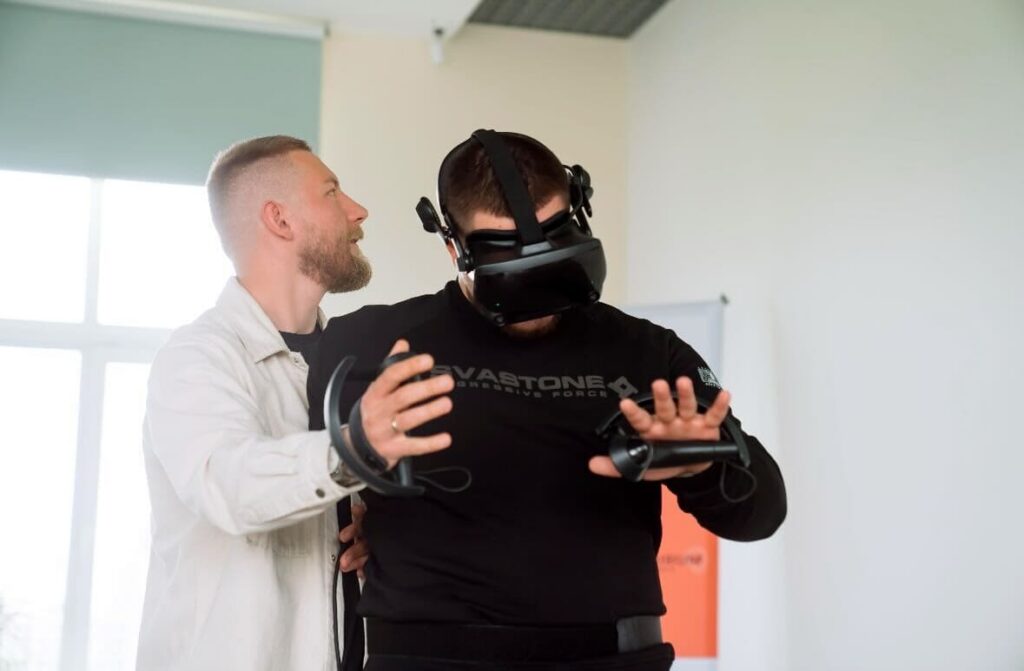
Just 10–15 years ago, virtual reality (VR) was seen primarily as a tool for games and entertainment. Today, however, this technology is being actively integrated into medicine, particularly in the field of rehabilitation. Scientific data from different countries confirm: VR can radically change the approach to treating phantom pain and restoring motor functions.
The VRNOW team closely follows global research, as it forms the foundation for implementing innovations into practice. Below are several key findings that demonstrate the effectiveness of VR in medical rehabilitation.
1. Visual Feedback Reduces Pain
A systematic review of 15 clinical studies (PubMed, 2024) showed that VR therapy significantly reduces the intensity of phantom pain—sometimes even after a single session. The best results are observed when VR is combined with tactile stimulation. This means that the effect of VR is not limited to a “visual illusion” — it can actually reprogram the patient’s sensorimotor system.
2. Effectiveness Comparable to Mirror Therapy
Mirror therapy has long been considered a classic method of combating phantom pain. However, a meta-analysis of 15 studies (PubMed, 2022) demonstrated that VR shows similar effectiveness.
Reduction of pain according to the Visual Analog Scale:
- VR: –2.24 points
- Mirror therapy: –2.54 points
Thus, VR can be viewed not only as an alternative but also as a more flexible tool capable of incorporating diverse scenarios and levels of complexity.
3. Restoring Motor Perception
According to studies in Frontiers, VR therapy significantly improves the mental representation of movements. When a patient performs movements in VR that they cannot physically execute, the brain begins to “rewrite the body map.” This effect correlates with reduced phantom pain, particularly during imagined movements such as grasping or twisting.
4. Sense of Ownership and Control
One of the most important findings: VR helps patients regain a sense of control over lost limbs. By combining visual and sensory stimuli, the sensorimotor loop—responsible for body awareness—is restored. This explains why many patients report not only reduced pain but also renewed confidence and psychological comfort.
5. VR Avatars as Therapy
A study in SAGE Journals showed that using a VR avatar with virtual legs reduced phantom pain by 39.6%. Participants performed movements simulating the activity of missing limbs, which had a significant therapeutic effect. This result confirms that VR is not just a “game for the brain” but a genuine medical tool.
International Evidence and Its Importance for Ukraine
International research demonstrates: VR technologies already have strong scientific validation, not just practical case studies. For us, as a Ukrainian team, this is extremely important because we are implementing VRNOW in clinics based not only on our own experience but also on evidence-based medicine.
- For patients — this means access to modern, scientifically proven recovery methods.
- For doctors — the opportunity to work with a tool that aligns with international protocols.
- For the state — a chance to create a rehabilitation system of a new level that meets global standards.
Conclusion
VR in medicine has already moved beyond the experimental stage. It is a proven, effective method that reduces phantom pain, restores motor functions, and gives people back the feeling of control over their bodies.
Today, Ukraine has a unique opportunity not just to catch up with the world but to become a leader in implementing VR in rehabilitation.
And VRNOW is part of this transformation.

